
Do I Need to Know How to Swim to Scuba Dive?
As a PADI dive instructor, one of the most common questions I hear is, “Do I need to know how to swim to scuba dive?” While it might seem like a straightforward question, the answer is a bit more nuanced than a simple yes or no.
Scuba diving is a unique activity that combines elements of swimming with specialized skills and equipment, making it accessible to a wide range of people. However, there are specific requirements and reasons why some swimming ability is necessary for safety and enjoyment.
In this blog, I’ll break down the various factors that come into play when considering whether swimming skills are needed for scuba diving. From the basic requirements for certification to the practical reasons why being comfortable in the water is important, we’ll explore what you need to know before taking the plunge into the underwater world.
Becoming Certified
If you want to become a certified scuba diver through the PADI Open Water Diver Course, the answer is yes, you do need to know how to swim. The course requires you to be able to swim continuously for 200 meters using any stroke of your choice, but the key is that it must be continuous, without stopping. As an alternative, you can complete a 300-meter swim using a mask, fins, and snorkel, which some people find easier than the 200-meter swim.
In addition to swimming, you must be able to tread water or float for at least 10 minutes. This requires you to stay in water deep enough that you cannot stand while keeping your head above the surface. Like the swim, this must be done continuously.

Why Swimming and Floating Skills Are Required for Certification
The reason PADI, the World Recreational Scuba Diving Training Council (WRSDTC), and other scuba training organizations require swimming skills is primarily for safety. While the act of scuba diving itself doesn’t necessarily require strong swimming abilities, these skills are crucial in emergencies.
For example, if your Buoyancy Control Device (BCD)—which helps you stay afloat at the surface—were to malfunction in deep water, you would need to rely on your swimming or floating abilities to reach safety, either by swimming to a boat or shore. Without these skills, a failure in deep water could lead to a dangerous situation, including the risk of drowning. Therefore, the ability to swim and float is essential for your personal safety.
Confidence and Skills
Being able to swim and float provides you with greater confidence in the water, which in turn helps when learning the 25 underwater skills required in the course. Often, individuals who are weak or non-swimmers tend to have less confidence in the water, making it more challenging to master the necessary skills.
Many of the underwater skills, such as removing your regulator (breathing device) or your scuba mask underwater, or simulating an out-of-air situation by turning off your air supply, can be mentally challenging. These tasks can be especially difficult for those who are already nervous in the water, highlighting the importance of being comfortable and confident.

Do I Need to Know How to Swim to Try Scuba Diving?
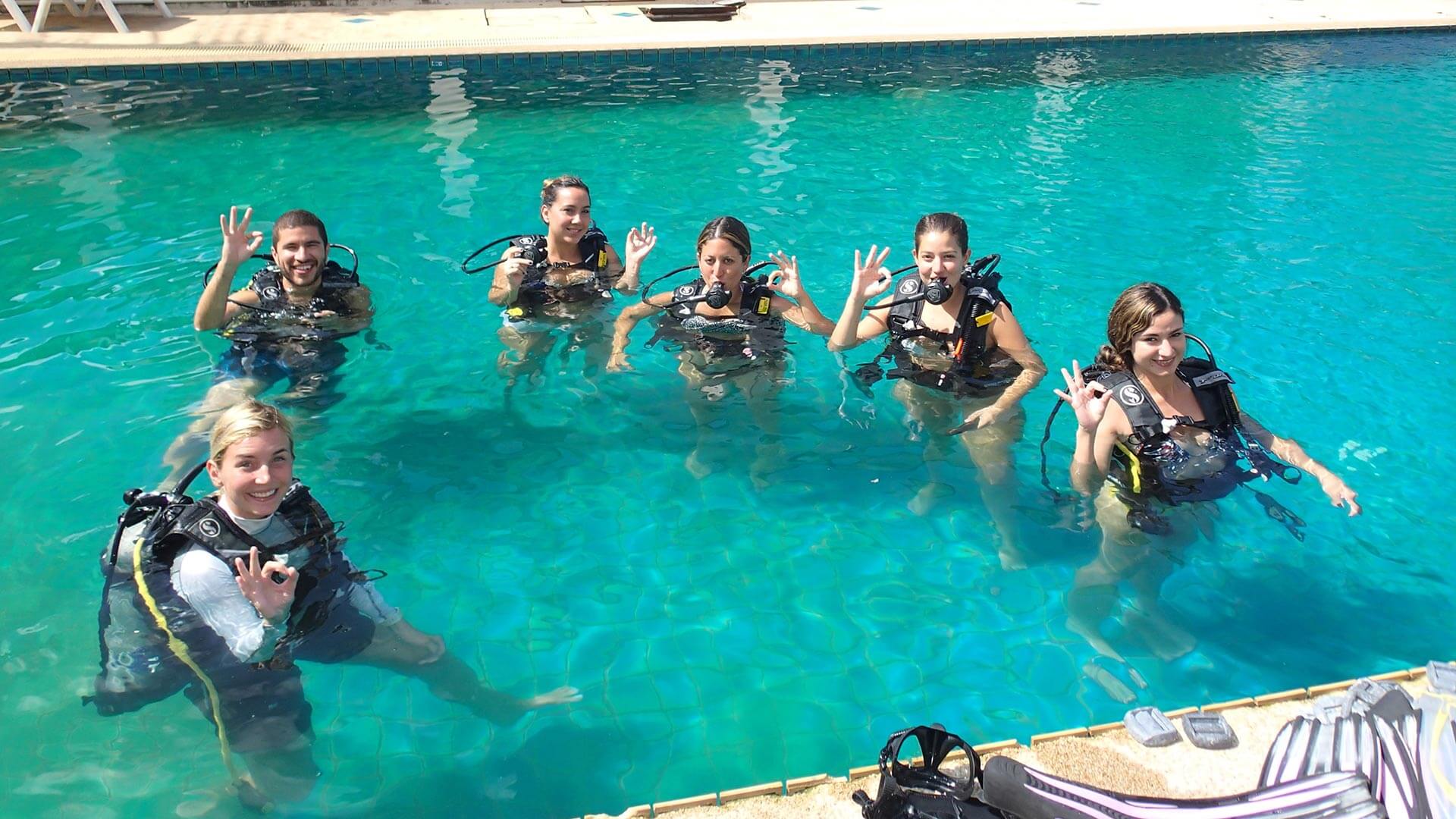
If you’re considering a PADI Discover Scuba Diving experience or a try dive, the short answer is no, you do not need to know how to swim.
There’s actually little correlation between swimming and scuba diving. Swimming is about staying above water, while scuba diving takes place underwater, where buoyancy and movement are managed differently. The primary skill shared between the two is the kicking technique, which is similar to a good freestyle kick. While strong swimmers may naturally do this well, non-swimmers can often learn the technique within a few minutes.
That said, scuba diving does take place in deep water, and knowing how to swim can provide a level of confidence that enhances the experience. While some non-swimmers often do complete the PADI Discover Scuba Diving program, there is also a high percentage that struggles and fail to complete the activity due to their lack of water skills and confidence.
During a Discover Scuba Diving session, PADI enforces strict student-to-instructor ratios, ensuring that your instructor is always nearby to assist in case of any issues. However, overcoming the fear of being in deep water can be a significant hurdle for non-swimmers, and it often prevents them from fully enjoying the experience.
New Scuba Divers
In my experience, new scuba divers face two main challenges: the initial act of scuba diving—breathing underwater for the first time—and a general fear of water, particularly for non-swimmers. While the thrill of seeing amazing marine life can help distract from the initial fear of breathing underwater, the fear of deep water is often harder to overcome.
For non-swimmers, the fear of deep water can trigger anxiety or even panic, leading to a less enjoyable experience. However, starting your scuba diving experience in shallow water or a swimming pool can help. Being able to stand up when needed can significantly ease both the fear of water and the fear of diving.

Learning to Swim
There’s an old saying: “You get out of life what you put into it.” Learning to swim is a valuable life skill that benefits you not just in scuba diving, but in many other aspects of life. Swimming is also one of the best forms of exercise, offering low-impact fitness benefits suitable for almost everyone.
It’s said that with two to three weeks of swimming lessons, an adult without a fear of water can become a functional swimmer. If you’re already a swimmer but feel that your skills are lacking, practising before your scuba course can give you an advantage.
Investing time in learning to swim is not only practical—it can also be a lot of fun!